
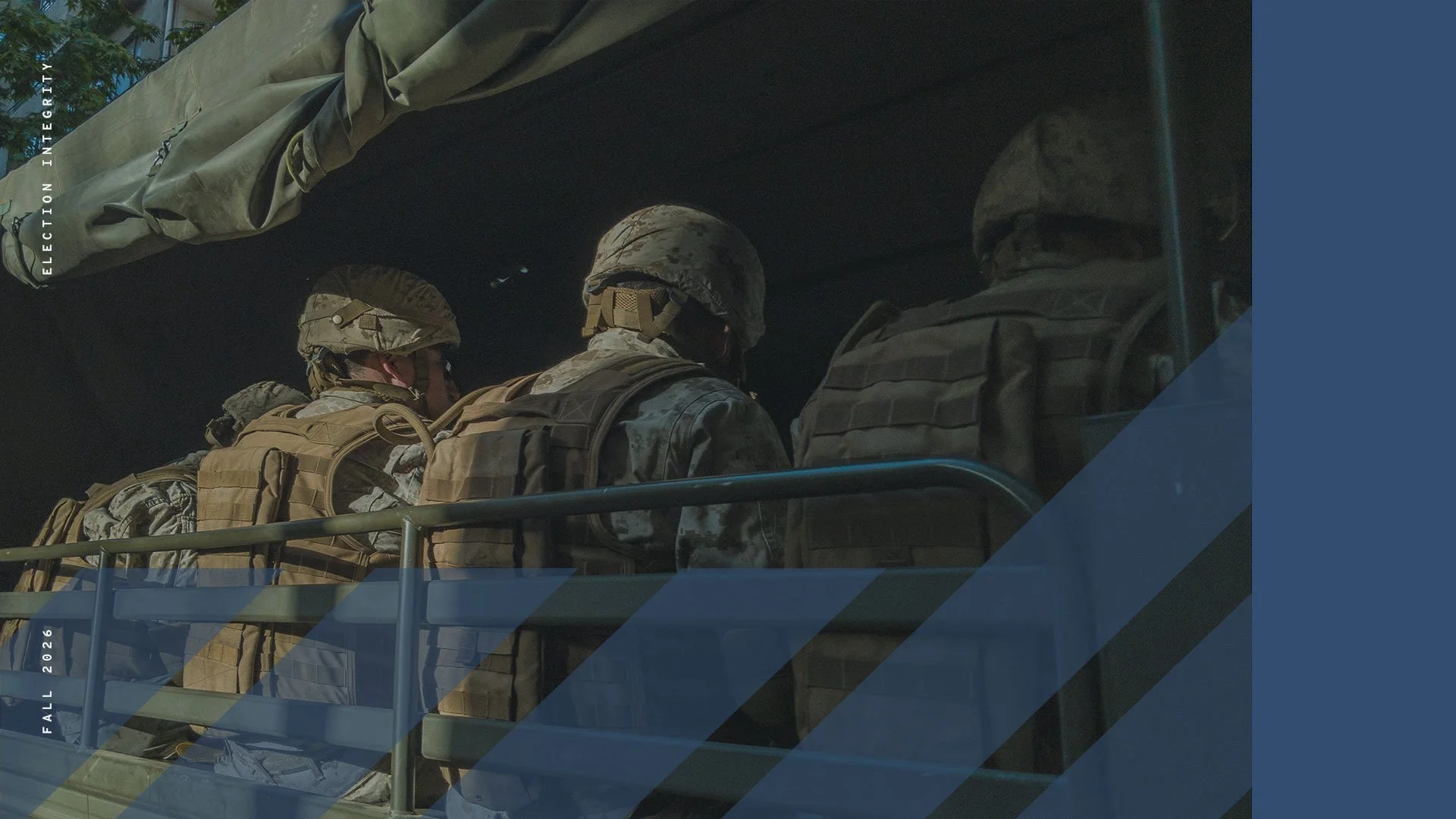
TOOLKIT FOR ELECTED OFFICIALS
MANAGING POTENTIAL MILITARY INTERVENTION IN THE MIDTERM ELECTIONS
Download the Toolkit for Elected Officials, provided by National Security Leaders for America and national organizations under the aegis of the Horizons Project, created to help mayors, county executives and other elected officials prepare to respond to a potential military intervention in their communities before, during, and after the midterm elections.
HOW TO USE THIS TOOLKITIn the toolkit, we address two distinct scenarios in which the Administration could arguably claim authority to deploy the military, and thus potentially affect the election outcome in key races by either suppressing voter turnout or confiscating voting machines and other election materials. In both scenarios, the military will be operating under what are initially presented as lawful orders.
The Administration could choose to invoke the Insurrection Act in response to civil unrest, deploying the military to protect civil order or to enforce federal law while effectively suppressing voter turnout in a major city. In a second scenario, military forces may be deployed to confiscate voting machines to protect against alleged hacking or other corruption of those machines by a foreign government with the potential of breaking the chain of custody of legally filed votes and impacting election results.
These two scenarios are not being addressed in otherwise robust election protection efforts being coordinated nationally. This toolkit addresses that gap. Protecting the elections requires a whole-of-civil-society response involving elected officials, law enforcement, election administrators, lawyers, faith, labor, business, veterans, and civic groups acting together under local leadership.
SCENARIO 01:
INVOCATION OF THE INSURRECTION ACT
By invoking the Insurrection Act, the President can exercise his authority to deploy federal forces for domestic law enforcement in limited circumstances, whether or not requested by the Governor, if the local situation is characterized as one where local law enforcement and the courts are no longer able to enforce local or federal law.
For example, in the weeks before the election, the Administration could claim that due to civil unrest in response to ICE or CBP actions, the mayor/county executive and local law enforcement are unable to maintain order and the judicial system is unable to properly function. Under these circumstances, the President could invoke the Insurrection Act and call up the military, deploying them to key cities to counter the growing protests, resulting in all likelihood in suppressing voter turnout in order to try to influence the election outcome.
As soon as civil unrest begins, it is the role of the mayor/county executive, local law enforcement, the judiciary and election officials to calmly but emphatically assert that the local situation is fully under control, on a daily if not more frequent public basis, until the crisis has passed. The Governor may also decide to deploy National Guard troops under the Governor’s authority to assist in maintaining civil order, in order to preempt any argument that regular military forces are needed.
THE RISK:
Troops would suppress voter turnout.
THE SOLUTION:
Daily press conferences as soon as civil unrest commences.
Download the toolkit for detailed instructions on how to respond in this scenario.
SCENARIO 02:
USE OF THE MILITARY TO ADDRESS AN ATTACK BY A FOREIGN GOVERNMENT
The Posse Comitatus Act prohibits the use of the military for domestic law enforcement purposes. Deploying the military to polling places is also specifically prohibited by criminal statute. Both laws have a common glaring exception: they do not prevent use of the military to respond to armed attacks.
Using that specific and legal exception, the Administration could claim that a foreign government (e.g., Iran, Russia, China) has conducted cyberattacks against or otherwise corrupted voting machines in some key target cities and deploy the military to polling places and/or ballot collection/counting facilities to confiscate voting machines and ballots and impact election results. In this scenario, the military could be at polling sites legally.
The mayor/county executive and law enforcement, in collaboration with civil society organizations, must work together to maintain order, encourage voters to keep voting, and support the efforts of election officials to protect the chain of custody of votes already cast.
THE RISK:
Troops break chain of custody.
THE SOLUTION:
Work with affected polling sites to protect the chain of custody of voted ballots. Help direct voters to other sites when necessary.
Download the toolkit for detailed instructions on how to respond in this scenario.
Questions? Need additional information? Please contact National Security Leaders for America at ElectionSecurity@nsl4ams.org.